


Ghosts of Salem

I am a Salem Witch Trials descendant. That means one or more of my ancestors were either someone who was accused of being a witch, someone who accused them, or they were part of the court proceedings. For most of my life, I had no idea.
In 2019 my wife and I decided to visit New England so I could do some research for a book series I was beginning to write about modern day witches in Salem. Two weeks before we left on that trip, I was in the middle of doing some genealogy research for a completely different project when I made a startling discovery. One of my great-grandmother’s ancestors was an accuser during the Salem Witch Trials.
Deacon Nathaniel Ingersoll had a tavern in Salem Village where most of the accused witches were taken between late February to early June prior to their examinations by the local magistrates, John Hathorne and Jonathan Corwin.

Location of the Ingersoll Ordinary in Danvers, MA. Photo by S.A. Sizemore © 2025
Nathaniel and his nephews, descended from his sisters, were also some of the main complainants during this time of the trials. Years later I discovered his great-niece, Mary Walcott, was one of the most infamous of the girls who claimed they were being afflicted by witches. One of the women they accused of being a witch, Bridget Bishop, became not only the first woman to be executed during the witch trials, but she was also the first person to be executed in Salem ever.
Nathaniel Ingersoll was listed as a witness on all of Bridget’s indictments along with Reverend Samuel Parris. It was the first and only time Nathaniel did this. After Bridget’s execution, all of the Ingersoll men (made up of Nathaniel, the Walcotts, the Houltons, and the Hutchinsons) stopped filing witchcraft complaints after her execution.
Bridget was targeted for many reasons. She was deemed argumentative and liked to barter, which was unseemly to the Puritans. Her second husband, Thomas Oliver, who was thirty years her senior, frequently beat her. They both were charged on two separate occasions for fighting in public. When he died in 1679, Bridget was almost immediately accused of killing him by witchcraft. My direct ancestor, John Ingersoll Sr., had his enslaved person, Wonn Indian, testify against Bridget at the trial. John Sr. was good friends with Thomas Oliver, and they frequently got into trouble protesting the local government.

Sketch of Bridget Bishop by S.A. Sizemore © 2026
The Ingersolls had a reason to go after Bridget Bishop in 1692. Knowing all this before I left on my trip to Salem made me wonder how much I should reveal about my ancestry while I was there.
We booked three different walking tours for our trip: a witch trials tour, the Salem Trolly tour, and a ghost tour. Each one provided a different viewpoint of Salem’s history, but the ghost tour ended up being the most personal for me.
We met our tour guide around 8 p.m. on Central Street. Our group was comprised a couple dozen people. The very first stop was the courtyard of Salem Green, which is enclosed by Salem’s City Hall to the south and Turner’s Seafood at the Lyceum Hall to the north. To the east was a strip of land once owned by my tenth great-grandmother, Margory Collins Williams. She was one of the midwives that performed a very invasive physical search of Bridget Bishop, looking for a “witch mark” on her skin. The findings were one of the things that helped convict Bridget.
Where we stood was adjacent to Bridget Bishop’s property. Specifically, we were right where her prized apple orchard used to be. Apples were a hot commodity in 17th century New England. Making fermented cider was how Salemites purified their drinking water, so Bridget very likely made money from the sale of apples. I had already wandered through that area a few times during our trip, and every time I did so, my head began to ache. That was strange because I rarely get headaches. It felt like someone was pressing their fingers against my temples.
Our tour guide stood in the darkened courtyard holding a lantern and began telling us about Bridget Bishop and why she was accused of being a witch. Then he proceeded to tell us that the spirit of a woman is sometimes seen in the courtyard. Staff at Turner’s often report of odd things happening in the restaurant, such as glasses falling from shelves, the scent of apples in the air, or lights flickering. They love posting videos of this whenever they get some poltergeist activity.
“When people stand here, they often complain about headaches,” our tour guide said.
I tried not to gasp when he said this.
Then he asked, "Has anyone experienced this while they’ve been in the courtyard?"
I was the only one who raised a hand.
According to our tour guide, people believe that’s how Bridget tries to get your attention. Then he asked me the question I had been trying to avoid answering all week.
“Is your family associated with the witch trials?”
Time to fess up. Nathaniel Ingersoll was my 11th great-uncle. I’m descended from his brother John. Thankfully, I didn’t have to explain what that meant. Our tour guide did it for me. Curious looks from the other guests quickly shifted to something else.
I had seen the dowsing rods our tour guide had brought with him, but he hadn’t used them yet. “Let’s see if we can talk to Bridget since she may be here with us right now.” Copper dowsing rods were created as a means of locating water but are now primarily used by paranormal researchers as a means of communicating with the dead.
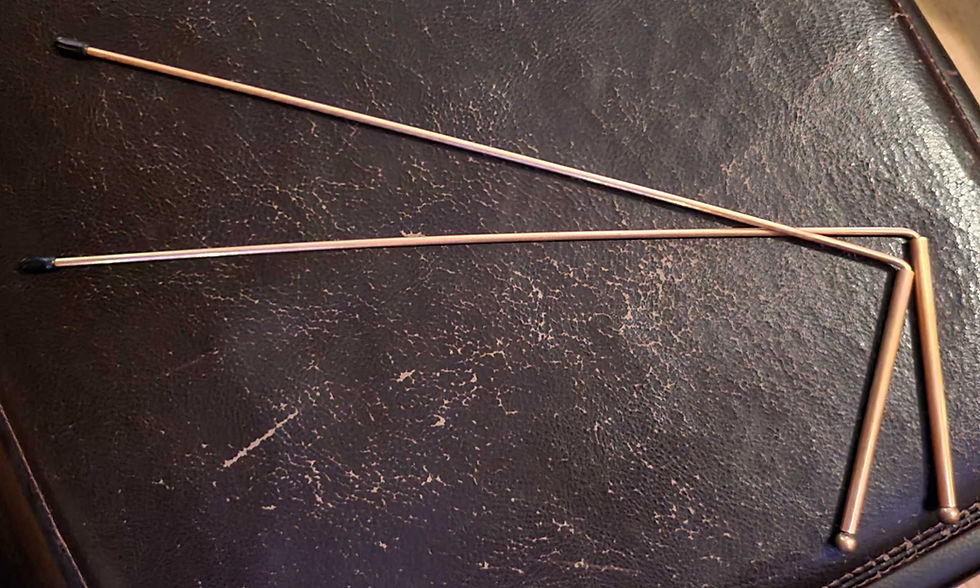
Photo of dowsing rods by S.A. Sizemore © 2026
I took in a long breath. How would this poor woman feel about me? I’m the descendent of her accusers and the woman who invasively searched her body the day of her trial. Wouldn’t Bridget be angry having me invade in her beloved orchard? Is that why she was trying to squeeze my head?
“Bridget, are you here with us?”
The dowsing rods hesitated for a moment then crossed into an X.
“What does that mean?” I asked.
“It means, yes,” he gently responded.
The hairs stood up on the back of my neck.
“Thank you, Bridget.” he said. Then he looked back at me. “Do you want to ask her a question?”
Again, deep inhale before I tentatively asked, “Bridget, do you know who I am?”
The dowsing rods crossed into an X again. Well, if I had her attention, I might as well go for it.
“Bridget, I am so sorry for what my ancestors did to you. Please accept my apology.”
Another X. Brief sigh of relief.
“I think she likes you,” our tour guide added with a smile. Two seconds later the dowsing rods crossed again in the affirmative.
I didn’t know if I wanted to laugh or to cry.
We continued on our tour and visited several other locations before ending up in the witch trials memorial just outside of Charter Street Cemetery where multiple members of my family are buried. Bridget’s memorial stone bench sits just to the right of the graveyard entrance. We all gathered around it and heard more about the Salem Witch Trials. Bridget was the first to go to Gallows Hill, and she was the only victim who was executed by herself.

Memorial stone of Bridget Bishop. Photo by S.A. Sizemore © 2026
As he spoke, I started to have the oddest sensation. It felt as if someone was lightly touching my right ear. I brushed my fingers against my neck, thinking it might be a bug. (Mosquitos love me in the summertime.) The tickling continued, so much so that I turned around to my wife to make sure she wasn’t teasing me. She was busy taking photos.
Before the tour disbanded, our guide confessed to me that he was also a descendant himself. His family were the Putnams. Later, during my extensive research of the trial records, I discovered that the Putnams and the Ingersolls were neck and neck in the amount of witchcraft complaints that occurred between February to August 1692. They accounted for about half of the accusations during the entire trails. Most of the people who were executed between June and September that year were initially accused by a Putnam or Ingersoll family member.
How odd that both of us came together that night during a ghost tour.
Although Bridget Bishop and I aren’t directly related, we do share the same family member. My first cousin seven times removed, Elizabeth Ingersoll, married John Beckett III, the great-great grandson of Bridget Bishop. Elizabeth is one of my family members buried in Charter Street Cemetery.

Grave of Elizabeth Ingersoll Beckett at Charter Street Cemetery in Salem.
Photo by S.A. Sizemore © 2025
So, was the ear tickling caused by Bridget, continuing to tease me? Or was it Elizabeth Ingersoll Beckett or one of several other ancestors who wanted to make sure I knew they were there?
Were we actually communicating with Bridget using the dowsing rods? Maybe or maybe not. Maybe people believe the rods are subconsciously being manipulated by the person holding them, telling us what we want to know. If we were, I’m glad Bridget doesn’t hate me. Even though I continue to get headaches whenever I linger in Salem Green, now I don’t wonder as much what’s causing them.
Instead, I say, “Hello, Bridget. I love you. Rest in peace.”
If you want to learn more about my family, the Salem Witch Trials, and Bridget Bishop, follow me on TikTok, Meta platforms, and YouTube @beckettcoven. My new Beckett Coven book series begins this September with Whispers of the Pale Witch from Rowan Prose Publishing. Although the primary story takes place in present day Salem, the Ingersolls and Bridget are intricately woven throughout its backstory. Find out more about those stories at www.beckettcoven.com.


Comments